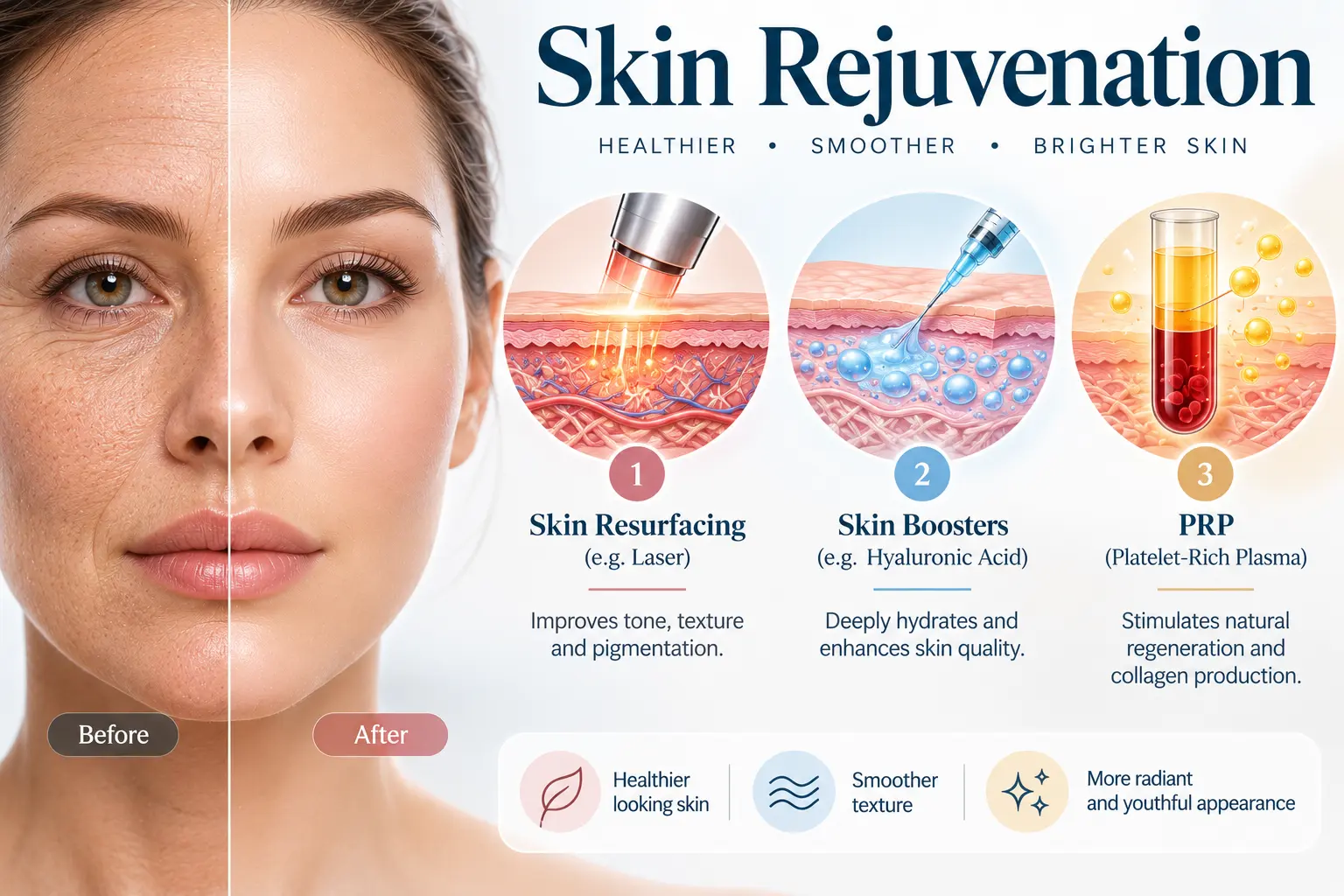
Skin Rejuvenation in Limassol: Assessment and Options
The clinician considers skin type, sensitivity, sun exposure, prior treatments, pigmentation risk and whether the concern is mainly surface texture, lines, scars or volume. Options may differ in expected effect, downtime, maintenance and evidence.
A realistic plan avoids combining treatments unnecessarily and should explain likely improvement, risks, aftercare and alternatives. Daily sun protection and consistent skincare can also influence skin health and the durability of cosmetic results.
What to discuss
- Your main concern and how long it has been present
- Skin sensitivity, pigmentation history and sun exposure
- Current skincare, medicines and previous procedures
- Acceptable downtime, budget and expectations
A treatment suitable for one skin type may increase irritation or pigmentation risk in another. Assessment should guide the choice and timing of any procedure.
Identify the skin concern first
Skin rejuvenation is an umbrella term rather than one specific procedure. A consultation should identify whether the main concern is uneven texture, fine lines, visible pores, acne scarring, pigmentation, dryness, redness or loss of firmness. These concerns have different causes and do not respond to the same treatments.
The assessment considers skin type and sensitivity, sun exposure, previous pigmentation changes, scarring tendency, active skin conditions, medicines and previous cosmetic procedures. The clinician should also ask how long the concern has been present, what has already been tried and how much downtime you can realistically accommodate.
How options are compared
Potential approaches may include a tailored skincare plan or selected clinical procedures, depending on the concern and the patient’s skin. The consultation should explain the purpose of each proposed option, the evidence for that indication, the expected degree of improvement, the time needed to see a result and whether maintenance is likely. The plan should not combine procedures simply because they are available.
Pigmentation-prone or sensitive skin may react differently to certain procedures. Active irritation, infection, recent tanning, some medicines and a history of abnormal scarring can change the timing or suitability of treatment. A safer plan may involve treating an underlying skin issue first or postponing a procedure.
- The skin feature you most want to improve and the result you would consider meaningful
- Your skin sensitivity, pigmentation history, sun exposure and tendency to scar
- Current skincare, medicines, allergies and previous procedures
- Likely downtime, number of visits, maintenance and total cost
- Potential irritation, pigment change, infection, scarring or other procedure-specific risks
Why realistic expectations matter
No procedure can stop normal skin ageing or guarantee that pores, lines, pigmentation or scars will disappear. Improvement may be gradual or partial, and more than one approach may be discussed over time. The clinician should explain what the treatment cannot achieve and what to do if the skin becomes irritated or the result is different from expected.
Daily sun protection and a consistent skincare routine are important parts of looking after skin, but they do not replace assessment of a changing, bleeding or otherwise suspicious skin lesion. Such a lesion should be evaluated medically rather than treated as a cosmetic concern.
Related options
Depending on the concern, separate information is available about skin boosters, PRP treatment and dermal fillers. These approaches have different purposes, products and risk profiles; a consultation should establish whether any is appropriate.
Questions patients often ask
Is there one best skin-rejuvenation treatment?
No. The best option depends on the specific skin concern, skin type, medical history and acceptable downtime.
Can treatments be combined?
Sometimes, but timing and combination should be planned to avoid unnecessary irritation and to assess how the skin responds.
Do I need to stop skincare before a procedure?
That depends on the procedure and products you use. Follow the individual preparation instructions rather than stopping prescribed treatment on your own.
The practice is based in Limassol, Cyprus. Patients from other towns can contact the clinic to discuss appointment availability and whether an in-person skin assessment is needed.
This information is general and does not replace an individual medical assessment.