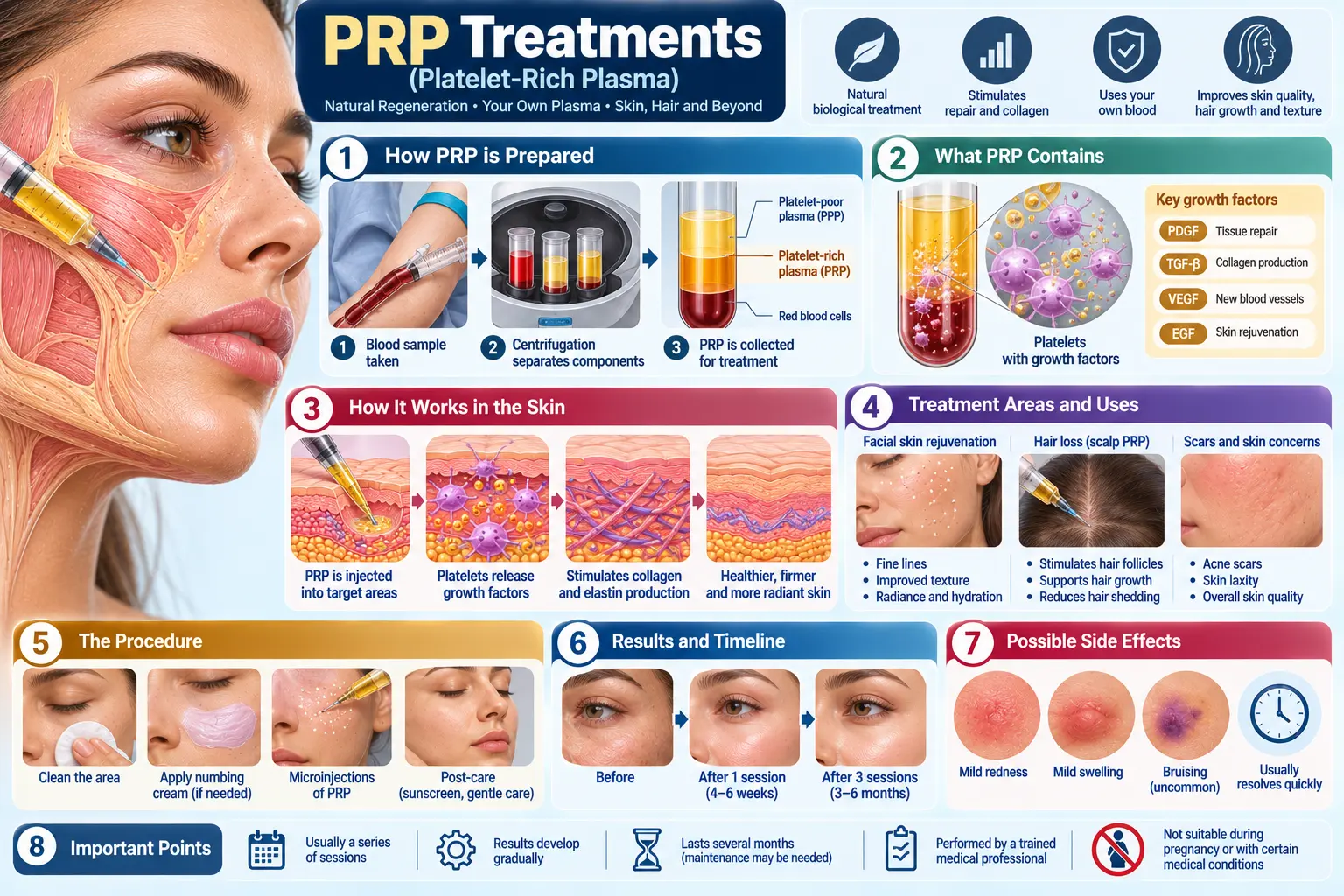
PRP Treatment: Evidence, Suitability and Expectations
PRP concentrates platelets from your blood and uses the prepared plasma as part of a selected skin treatment. Research suggests some people may see modest improvements in skin texture and the appearance of fine lines, but studies and protocols vary, and results are not guaranteed. PRP is not a replacement for every established skin treatment.
A suitability consultation should identify the exact concern, review medical history and medicines, explain the preparation and application method, and discuss evidence, possible side effects, alternatives, cost and expected follow-up. The plan should be clear about what is known and where evidence remains limited.
What to discuss before PRP
- Whether the concern is texture, fine lines, scars or another skin issue
- Medical history, medicines, bleeding concerns and previous procedures
- The proposed PRP method and whether combining treatments is suggested
- Likely number of sessions, downtime, risks and alternative options
PRP is not a guaranteed skin rejuvenation treatment. Published evidence is variable, so the decision should follow a realistic, individual discussion of expected benefit and uncertainty.
What platelet-rich plasma involves
Platelet-rich plasma (PRP) is prepared from a sample of a patient’s own blood. The sample is processed to concentrate platelets in a plasma component, which is then used according to the clinician’s treatment plan. Preparation systems, platelet concentration, activation methods, injection techniques and combinations with other procedures can vary. “PRP” therefore does not describe one uniform product or protocol.
PRP is discussed for selected skin-quality concerns, but the evidence is not equally strong for every indication. Published studies use different preparations and outcome measures, which makes results difficult to compare. Recent reviews describe promising findings for some skin-quality outcomes while also noting limitations in overall evidence quality and lack of standardisation. PRP should not be presented as a guaranteed rejuvenation treatment or as a way to restore facial volume.
What suitability depends on
- The concern being treated and whether PRP has evidence for that specific use
- Your medical history, blood conditions, platelet disorders and tendency to bruise or bleed
- Medicines and supplements, including anticoagulants or medicines that affect blood clotting
- Skin infection, inflammation or other conditions at the intended treatment site
- The preparation kit, sterile handling, proposed injection or application method and follow-up plan
Do not stop prescribed medicines before a procedure unless the prescribing clinician tells you to. The clinician should explain whether any medicine or medical condition changes the risk, and whether another option is more appropriate.
Possible effects, risks and recovery
Because PRP involves a blood draw and injections or skin penetration, temporary discomfort, bruising, swelling, tenderness and redness can occur. Other risks relate to the injection technique and the condition of the skin, including infection, prolonged inflammation or an unexpected reaction. Sterile equipment, correct preparation and clear product handling are essential.
The number and spacing of sessions should be based on the intended use, evidence and review of response; there is no single schedule that applies to everyone. Ask what improvement would count as meaningful, when it will be assessed, what the treatment cannot do and what alternatives are available. If there is no clear clinical rationale, choosing not to proceed is reasonable.
Questions patients often ask
Is PRP completely risk-free because it uses my own blood?
No. The source material is your own blood, but blood collection, processing and injection still involve procedural risks, including bruising and infection.
Will PRP replace fillers or surgery?
No. PRP is not a volume replacement treatment and is not a substitute for procedures designed for structural or volume changes.
How many sessions are needed?
Protocols vary by indication and preparation. A specific plan should explain the reason for each session and how response will be reviewed.
Related assessment and treatment information
Further patient information
The clinic is in Limassol. Patients living elsewhere in Cyprus can contact the practice to ask about an appointment and whether an in-person consultation is suitable.
This information is general and does not replace an individual medical assessment.