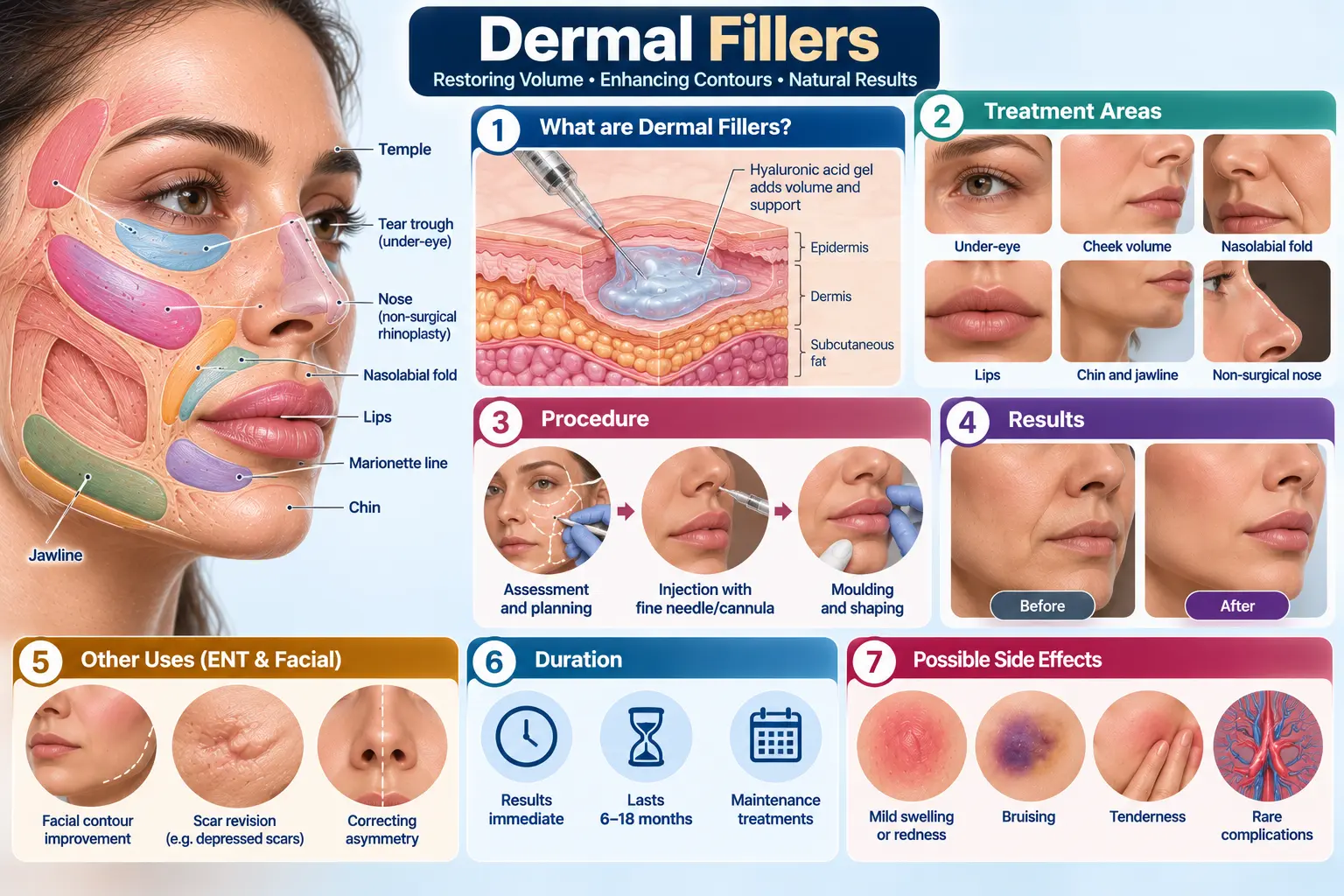
Dermal Fillers: Facial Assessment, Suitability and Safety
Fillers are injectable products used to add or restore volume in selected areas or soften certain contours. The material, amount and placement depend on the treatment goal. Fillers do not stop ageing, and more product does not necessarily produce a better or more natural outcome.
A consultation should cover the product proposed, its expected duration, alternatives, previous filler history and possible complications. Rare but serious risks, including vascular compromise, should be discussed, and treatment should be performed by an appropriately qualified clinician with a plan for managing complications.
Information to share before treatment
- Areas of concern and the change you hope to see
- Previous fillers, dissolving treatments or facial procedures
- Medical conditions, medicines, allergies or bleeding concerns
- Any history of cold sores or unusual reactions to injections
Filler treatment is not risk-free and may be inappropriate in some areas or circumstances. An informed consultation should include alternatives, risks and a clear aftercare plan.
How filler treatment is planned
Dermal fillers are injectable products used for selected contour or volume concerns. The right discussion begins with facial anatomy, skin quality, proportions and the specific change you hope to make. A clinician should explain whether a filler is relevant to that concern or whether another option would be more suitable.
The term “filler” covers products with different materials, properties and intended uses. Their duration, reversibility, injection depth and risk profile are not identical. The product, treatment area and intended use should be identified clearly before consent; a brand name alone is not enough information.
Risks that must be discussed
Temporary swelling, bruising, redness, tenderness and discomfort can occur. Other complications include infection, inflammatory nodules, delayed reactions, migration or persistent lumps. A rare but serious complication occurs when filler enters or compresses a blood vessel and interrupts blood supply. This can cause skin injury and, in some circumstances, visual loss or stroke. The risk depends on the product and injection site, but it must be explained before treatment.
Ask how the clinician recognises and responds to a suspected vascular complication, what emergency arrangements are available and how you can contact the clinic after the procedure. Some filler materials are difficult to remove; even when an enzyme can dissolve a particular hyaluronic-acid filler, removal is not always simple and has its own limitations.
- The exact product, ingredients, manufacturer and authorised intended use
- The proposed area, amount, technique and alternatives
- Previous fillers, dissolving treatments, facial surgery or dental procedures
- Medicines, allergies, bleeding conditions, active infection or a history of cold sores
- The aftercare plan and who to contact if pain, colour change or visual symptoms occur
When to seek urgent help
Severe or unusual pain, skin that becomes unusually pale, grey or blue, sudden visual disturbance, weakness, facial drooping, difficulty speaking or a severe unusual headache during or after an injection may signal a serious complication. Seek emergency medical help immediately; do not wait for a routine clinic reply.
A filler consultation should also be a chance to decide not to proceed. A conservative plan, an alternative treatment or no treatment may be the safest choice when the expected benefit is uncertain or the requested area is not appropriate for the product.
Questions patients often ask
Are all fillers the same?
No. Materials, duration, indications and risks differ. Ask for the exact product and its patient information before consenting.
Can filler always be dissolved?
No. Removal depends on the material and the complication. Some products are difficult or impossible to remove completely.
Does more filler create a better result?
Not necessarily. Excess volume can distort proportions and may increase risks. Planning should be based on anatomy and a measured goal.
Related assessment and treatment information
Further patient information
The practice is located in Limassol, Cyprus. Patients from elsewhere on the island may contact the clinic to ask about an appointment and the need for an in-person assessment.
This information is general and does not replace an individual medical assessment.