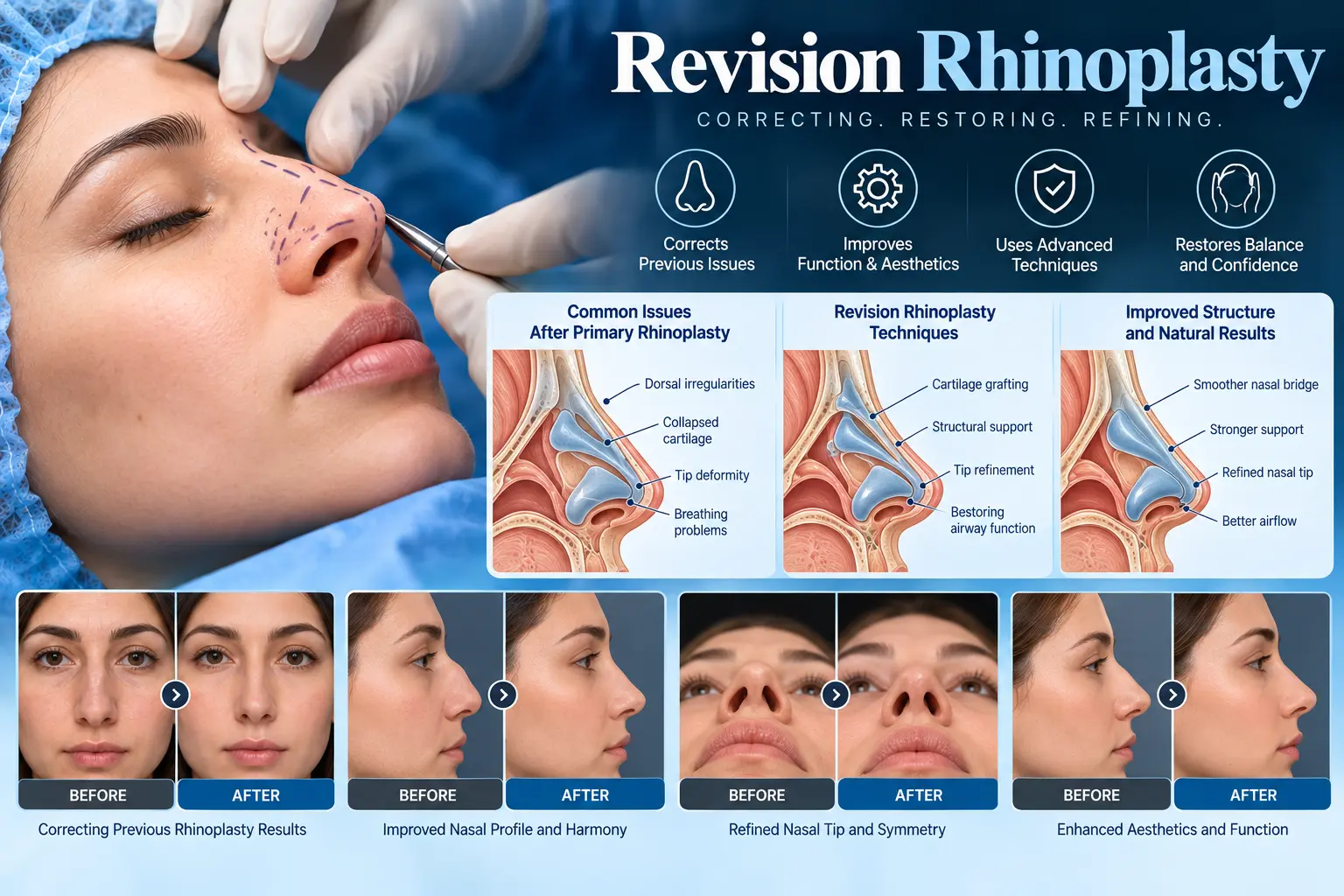
Revision Rhinoplasty in Cyprus: Assessment and Planning
Previous surgery changes the nasal framework and available cartilage, and scar tissue may make correction more complex. Assessment includes breathing, symmetry, skin and support, previous operative details and how long healing has progressed.
Revision surgery is not always the best next step, and complete symmetry or a specific result cannot be guaranteed. The consultation should cover timing, possible need for cartilage grafts, risks, recovery and the option of not operating.
Bring details of the previous procedure
- Date and type of previous surgery, if known
- Operating notes or photographs from before and after surgery
- Current breathing concerns and the changes that trouble you
- Any complications, injections or treatments since the operation
Further surgery is often considered only after sufficient healing and careful assessment. A clear discussion should include what is possible, what is uncertain and how risks differ from a first operation.
Why revision surgery needs individual planning
Revision rhinoplasty is considered when a person has ongoing functional or appearance-related concerns after previous nasal surgery. It is often more complex than a first operation because the nasal framework may have been changed, cartilage may have been removed or reshaped, scar tissue may be present and the skin and soft tissues may have healed differently than expected.
The assessment should separate breathing concerns from appearance concerns, while recognising that both can be connected. The clinician examines nasal support, alignment, the septum, nasal valves, turbinates, skin characteristics and the available structural framework. The stage of healing after the previous operation is also important.
Records and information that help
- The date, type and location of your previous operation, if known
- The operative report, implant or graft details and discharge summary, if available
- Photographs from before surgery and different stages of recovery
- Current breathing symptoms, pain, numbness, swelling or skin changes
- Any infections, complications, injections, trauma or further procedures since surgery
- Your main priorities and which changes would make a meaningful difference
Previous operative notes can help explain what was changed and which cartilage or support structures remain. Their absence does not prevent an assessment, but it may add uncertainty to planning. Imaging is considered only when it helps answer a specific clinical question; photographs alone cannot establish the internal cause of obstruction.
Options, grafts and realistic outcomes
Depending on the findings, options may include observation, treatment of a separate breathing problem, a limited correction or a more extensive revision procedure. Some operations require additional cartilage to restore support. The possible source and consequences of any graft material should be discussed in advance. Not every visible irregularity is best treated surgically.
Complete symmetry, a particular profile or a guaranteed breathing outcome cannot be promised. Further surgery carries risks such as bleeding, infection, scarring, persistent obstruction, contour irregularity, altered sensation and the possibility that another procedure may be considered. The expected benefit should be weighed against these risks and the option of not operating.
Timing and recovery
Revision planning generally requires enough time for swelling and scar maturation after the previous operation. The appropriate interval varies with the type of surgery, healing, complications and the reason for revision. A decision should not be based on impatience with early swelling alone. The clinician should explain why the timing is appropriate in your case.
Recovery may be less predictable than after a first operation, and the final appearance can continue to change as swelling settles. Before proceeding, ask about restrictions, follow-up appointments, warning symptoms, work and activity planning, and how the team will review both nasal function and appearance.
Related nasal surgery information
Where breathing is the main concern, see functional rhinoplasty and nasal valve assessment. For a first-time appearance-focused procedure, see cosmetic rhinoplasty. These pathways address different questions and are not interchangeable.
The clinic is based in Limassol, Cyprus, and appointment enquiries are welcome from patients throughout the island. Revision planning requires an individual examination and review of any available previous operative records.
This information is general and does not replace an individual medical assessment.