
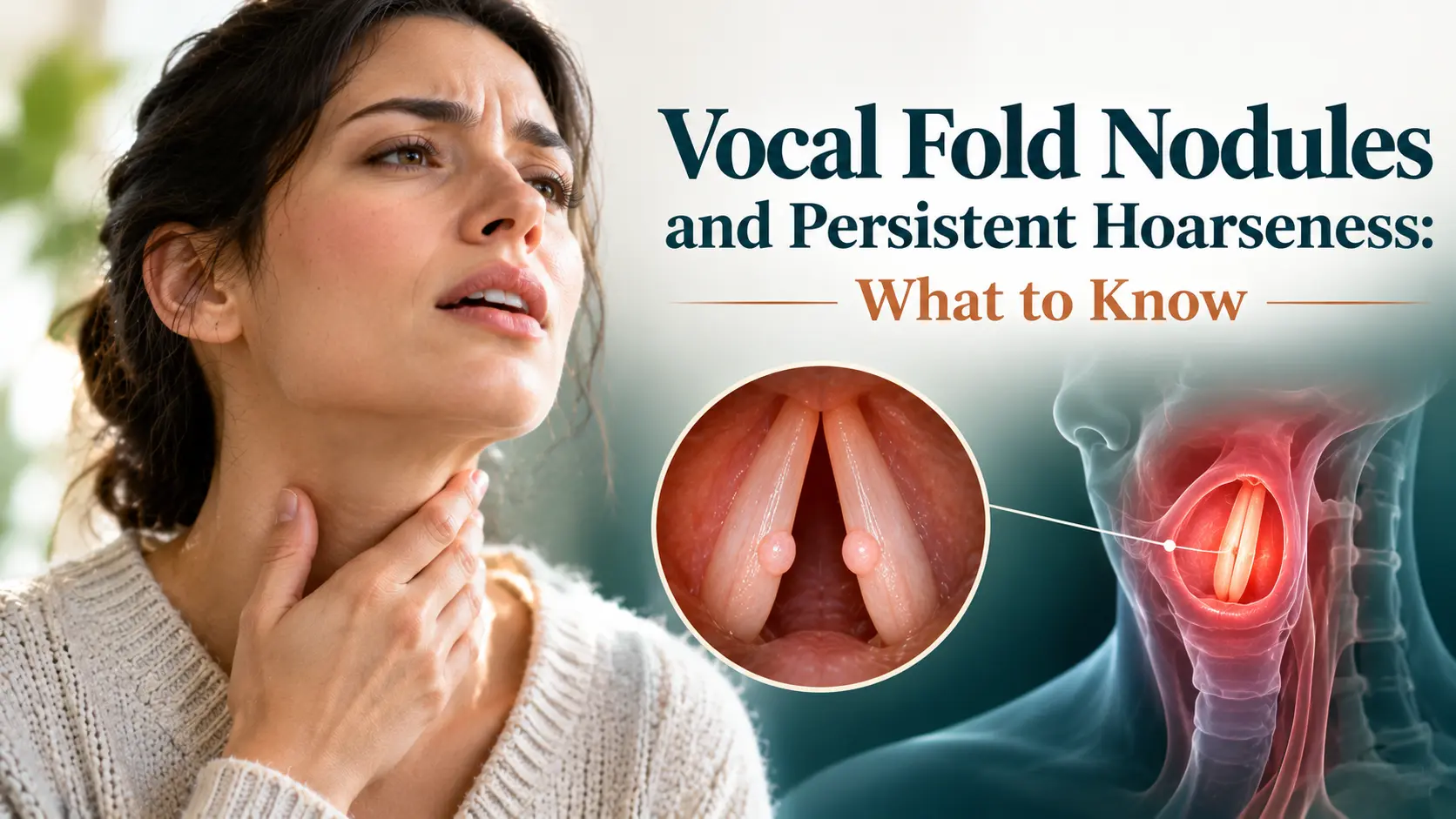
Vocal-fold nodules are small areas of thickening that can develop where the vocal folds repeatedly make forceful contact. They are associated with vocal overuse or inefficient voice production and can cause persistent hoarseness, vocal fatigue, reduced range, or a rough voice. Other lesions and medical conditions can create similar symptoms, so an examination is needed before naming the cause.
How they affect voice production
The vocal folds normally vibrate in a coordinated way to produce sound. Swelling or thickening can interfere with vibration and make the voice breathy, rough, or effortful. People who sing, teach, coach, or speak loudly for long periods may be exposed to greater vocal load, but nodules are not limited to professional voice users.
An ENT clinician may examine the larynx with a small flexible or rigid scope. Sometimes stroboscopy or other specialised assessment is useful to observe vocal-fold vibration. The aim is to identify the lesion, understand contributing behaviours or illnesses, and rule out other causes of persistent hoarseness.
Treatment is usually individual
Voice therapy can help many people reduce harmful vocal habits and use the voice more efficiently. A plan may include hydration, voice breaks, amplification, reducing shouting, and addressing contributing irritants. Surgery is not the first step for every nodule; decisions depend on the diagnosis, voice needs, response to therapy, and specialist findings.
Do not assume that a throat lozenge or reflux medicine will remove a vocal-fold lesion. If a treatment has not helped, return for review instead of continuing indefinitely. Vocal exercises should be selected for the specific voice problem, because the wrong technique may increase strain.
Why persistent hoarseness matters
Hoarseness that persists beyond a few weeks, repeatedly returns, or affects work should be assessed. Other warning signs include breathing difficulty, swallowing pain, a neck lump, coughing blood, unexplained weight loss, or a substantial smoking history.
Seek emergency care for breathing difficulty or rapidly increasing throat swelling. A professional diagnosis can help set realistic expectations and protect the voice over the long term.
Common questions
Do vocal-fold nodules always need surgery? No. Many are managed with voice therapy and changes in vocal load; surgery is considered selectively after examination.
Can I keep singing through hoarseness? Continuing to strain a hoarse voice may worsen symptoms. Reduce vocal load and get assessed if the change persists or repeatedly returns.