
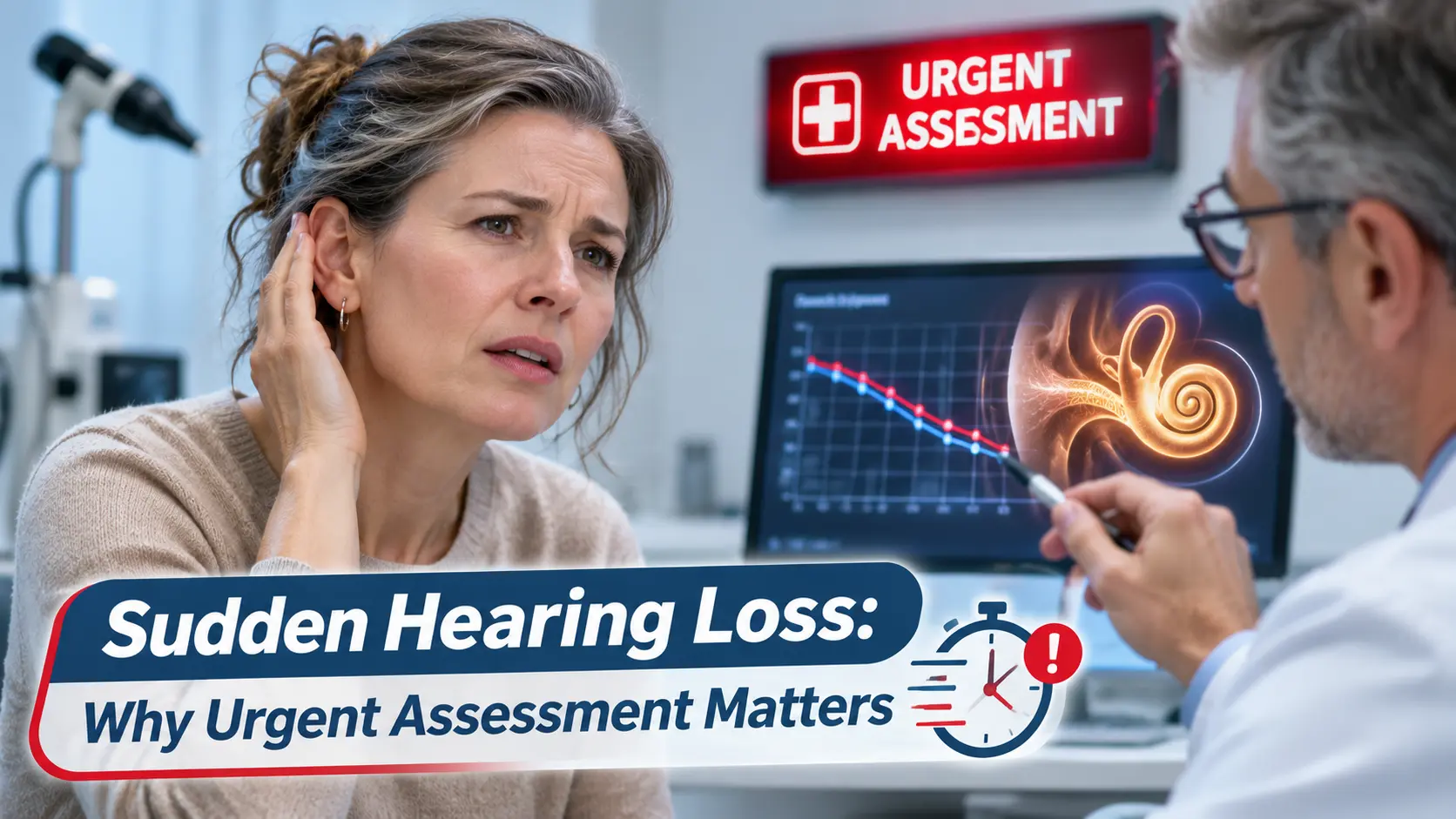
A sudden change in hearing in one or both ears should be taken seriously. It may be noticed when waking up, using a telephone, or realising that speech sounds unusually muffled. Some people also experience ringing (tinnitus), dizziness or a feeling of fullness. Because a blocked-ear sensation can accompany inner-ear hearing loss, it is not safe to assume that wax or congestion is the cause.
What counts as sudden hearing loss?
Sudden sensorineural hearing loss is a rapid reduction in hearing caused by a problem in the inner ear or the hearing pathway. It can develop all at once or over a few days, often affecting one ear. Other conditions, such as wax or fluid, can also reduce hearing, so an examination and hearing test are needed to distinguish them.
What should you do first?
Seek urgent same-day medical assessment when hearing has suddenly reduced. Do not wait several days to see whether it clears, and do not delay assessment while trying wax-removal products or home remedies. If urgent outpatient assessment is not available, use the local urgent or emergency care pathway.
This is particularly important if the change comes with new tinnitus, dizziness, or pressure. These symptoms do not prove inner-ear damage, but they can occur together and should be reported.
Why timing matters
Sudden inner-ear hearing loss has several possible causes, and many cases do not have an identifiable cause at first assessment. Some treatment options may be time-sensitive. The earlier a clinician evaluates the hearing change, the sooner they can decide whether treatment is appropriate and whether other causes need investigation. Improvement can sometimes occur without treatment, but it is not possible to predict this safely at home.
What happens during assessment?
A clinician will ask when the change started, which ear is affected, and whether there has been pain, discharge, noise exposure, recent illness, dizziness, trauma or a medication change. They may examine the ear canal and eardrum to identify a blockage or middle-ear problem. A formal hearing test, often pure-tone audiometry, helps determine the type and degree of hearing loss. Further tests may be considered according to the findings.
How is sudden hearing loss treated?
Treatment depends on the diagnosis and individual circumstances. For sudden sensorineural hearing loss, a clinician may consider corticosteroid treatment after assessing potential benefits, risks and timing. Do not take prescription steroids or alter regular medicines without medical advice. If another cause is found, management will be directed at that cause.
Can hearing loss be prevented?
Not every sudden hearing problem is preventable, but protecting hearing from loud noise is worthwhile. Turn down personal audio, move away from excessive noise when possible, take quiet breaks and use suitable hearing protection in noisy environments. Avoid inserting objects into the ears.
When is emergency care especially important?
Sudden hearing loss itself warrants urgent assessment. Seek emergency help immediately if it occurs with facial weakness, difficulty speaking, new weakness or numbness, severe sudden headache, major head injury, or other possible neurological symptoms.
Common questions
Could it just be earwax? It could, but the sensation alone cannot distinguish wax from sudden inner-ear hearing loss. Do not self-diagnose.
What if hearing returns partly? A sudden change still deserves prompt evaluation, even if it improves.
Should I wait for an ENT appointment next week? Do not postpone urgent assessment because a routine appointment is unavailable; seek an appropriate same-day medical route.
Explore our ENT consultation page for more information about this care option. A clinician can advise based on the individual history and examination findings.
Sources and further reading
Educational information only; this article is not a substitute for urgent medical assessment.